Unlock Commercial Solar Panels Ontarioin 2026: A Straight-Talking Guide
Unlock Commercial Solar Panels Ontarioin 2026: I’ve worked around enough Ontario roofs and solar quotes to know homeowners want a clear answer, not a sales pitch. Here’s the honest version of what commercial solar panels ontario buyers actually need before signing anything — real numbers, real incentives, real trade-offs.
Is Solar Worth It in Ontario?
Many homeowners across Ontario ask whether solar pays off, and the answer shifts with location, budget, and goals. The Ontario Homeowners’ Consumer Council cites financial savings, sustainability goals, and tighter climate targets, while Terawatt Solar notes strong long-term returns even in colder climates, thanks to falling panel costs and better solar technology. Ontario gets 1,100 kWh to 1,300 kWh per square meter yearly, keeping solar electricity generation realistic through seasonal variations; net metering programs bank surplus summer energy against slower winter production, and cold temperatures barely hurt output since efficient systems now handle overcast conditions well.
Read More About Solar Panel Ontarioin
Unlock Commercial Solar Panels Ontarioin 2026. CMI Solar reports most Ontarians hit breakeven points within 7 years to 12 years, sometimes 8 years to 10 years, faster still with battery storage or EV charging systems. A firm like Roof Pros Plus stresses that a durable roof must match a solar system’s durable systems lifespan, since rebuilding a south-facing roof midway multiplies maintenance costs and disrupts the solar investment. Once a home’s annual power expenditure exceeds about $1,200, rising electricity costs, hydro dependence, and rising hydro bills push the calculation farther toward solar.
Add shrinking federal programs like the Canada Greener Homes Grant, growing energy literacy, better consumer protection, and easier financing, and 2025 into 2026 looks workable — provided the roof isn’t shaded, isn’t due for replacement, and the household isn’t moving soon, since installation feasibility, HRS pre-approval, and a proper net-metering setup all take time. Commercial solar panels are important since there are no short cuts when it comes to costs, solar potential, clean power, shading danger, or clean energy upgrades. ontario shoppers check roof condition first.
What Solar Costs in Ontario / Cost Saving
Here are the real numbers. Installed PV runs $2.42 to $3.50 per watt: a 5 kW system costs $12,000 to $17,500, a 7.5 kW setup $18,000 to $26,000, and a 10 kW array $24,000 to $35,000, producing 5,500 kWh to 6,500 kWh, 8,500 kWh to 9,500 kWh, or 11,000 kWh to 13,000 kWh of annual production. The HRS solar rebate, also called the HRS rebate or up-to-$5,000 rebate, drops those same systems to $7,000 to $12,500, $13,000 to $21,000, or $19,000 to $30,000 based on system size.
Through overnight arbitrage on the extremely low overnight rate, a home battery adds between $10,000 and $18,000. Older choices included 30% installation cost rebates, the $5,000 first Canada Greener Homes Grant, and interest-free loans up to $40,000 for energy-efficient upgrades — both provincial incentives and older federal incentives worth checking in 2026. Expect reduced energy bills, lower utility bills, less grid reliance, smaller energy expenses, and annual savings of $1,000 to $2,500 depending on household consumption and peak usage, plus Tax Credits on top.
Payback Period
The payback period in Ontario now falls somewhere between 7 years and 12 years, tightening to about 8 years to 9 years once the HRS rebate pairs with a battery, and stretching closer to 13 years on net metering alone. Even when hydro prices continue to rise, most homeowners benefit from an additional decade or more of affordable electricity after the initial investment clears because panels come with warranties that last for 25 to 30 years. The same energy savings also tend to increase property value.
CMI Solar puts typical recoup investment timelines at roughly 8–12 years, which lines up with what most Ontario households actually experience.
Government Incentives / Rebates & Net Metering
The federal government and local utilities have long offered government incentives for energy upgrades, renewable systems, and home efficiency improvements, easing the initial investment in residential solar.
The Canada Greener Homes Grant closed to new applicants in early 2024, with final reimbursements ending December 31 2025; the Greener Homes Loan closed in October 2025, so don’t budget around that old $5,000 federal grant. In its place, the Home Renovation Savings Program (HRS) offers $10,000 in stackable rebates covering rooftop solar PV and battery storage, requiring pre-approval since retroactive applications get rejected.
The alternative, net metering under Ontario Regulation 541/05, gives a 1:1 credit at the retail electricity rate and allows a larger system up to the 12 kW AC cap, raised from 10 kW in 2024; export credits offset only the electricity charge, not delivery charges, regulatory charges, or HST, and reset every 12 months. Over a 25-year return, HRS plus load displacement usually beats net metering, though your usage pattern decides it — worth asking any commercial solar panels ontario installer about directly. Even though they are mostly retired, older rebates, 30% installation cost tax credits, and interest-free loans up to $40,000 from the Canada Greener Homes Loan are still listed.
How Many Panels / System Sizing
Sizing starts with real numbers. An average household uses close to 9,500 kWh of electricity a year, though house size, heating source, occupants, and habits swing that a lot, so pull 12 hydro bills for an honest annual total. Divide by 0.80 for system losses, giving roughly 11,900 kWh; divide again by the usable sun equivalent of 1,150 kWh per kW, and most homes need a 10 kW to 11 kW system, or 25 panels to 28 panels at 400 W panels each, needing 17 sq ft to 20 sq ft apiece — roughly 450 sq ft to 550 sq ft, a two-car-garage footprint.
Read More About Air Craft
A small efficient home needs 15 panels to 20 panels (6 kW to 8 kW); an average single-family home needs 20 panels to 30 panels (8 kW to 12 kW); a large home, especially an electrically-heated home, can need 30 panels to 40 panels or beyond. Many owners offset just 50% to 75% of usage to stay under the net-metering cap. A south-facing roof, or southeast or southwest, at a 30 degree pitch to 45 degree pitch, shade-free from 9 a.m. to 3 p.m., performs best, though micro-inverters make an east-facing roof or west-facing roof workable despite reduced output. System sizing, physical sizing, and system costs all move together.
Environmental Benefits / Reduced Carbon Footprint
Every kilowatt-hour a solar array produces avoids emissions tied to traditional electricity sources, shrinking a household’s carbon footprint and cutting reliance on fossil fuels. Over 25 years, a typical system can offset more than 60 metric tons of CO₂, a solid case for a renewable energy source built on clean energy and sustainable energy rather than pollutants and greenhouse gases. Pair it with energy-efficient appliances and other home upgrades and the ecological footprint shrinks further. Unlock Commercial Solar Panels Ontarioin 2026:
There’s a benefit for air quality too: less air pollution, fewer sulfur dioxide and nitrogen oxides emissions, less smog, and fewer respiratory problems — a healthier future for Ontarians.
Energy Independence
Cutting reliance on grid power gives a household control over its own energy usage. During outages, or high demand stretches, a system with battery storage keeps the lights on, offering reliability through unpredictable weather and infrastructure failures. Solar supports a diversified energy mix and a decentralized energy model, building resilience for rural communities and remote communities prone to power outages.
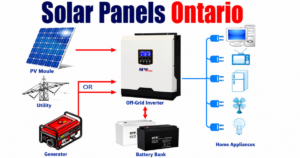
Through hybrid setups or off-grid setups, backup power from lithium-ion batteries delivers year-round power security, and a smart home energy management system stretches grid power reserves further.
Job Creation & Economic Impact
Solar industry growth in Ontario is driving job creation, from installers and engineers through the green economy and clean tech sector. In 2023, the solar sector supported over 80,000 jobs, climbing as more provinces chase clean energy targets. The work spans installation jobs and maintenance jobs — site assessment, panel installation, wiring, system integration — backed by training programs at technical colleges and trade schools offering certifications for tradespeople and electrical contractors, boosting employability and earnings potential.
Solar also brings economic stimulus to local economies through procurement, logistics, and financing, since solar projects, including commercial solar panels ontario installs, cut environmental costs while strengthening local solar companies, regional economic development, and environmental resilience.
Increased Property Value
A well-built residential solar energy system holds down electricity costs for 20 years to 30 years, delivers real energy independence, cuts fossil fuels reliance, shrinks carbon footprint and carbon emissions, and lifts property value.
Buyers notice: real estate reports show faster sales and higher market values for homes with energy storage solutions, since shoppers recognize the long-term cost savings and eco-consciousness of solar properties — a detail that matters for commercial solar panels ontario buyers too.
Solar Technology Is More Efficient
Modern solar PV systems produce more electricity generated per square foot than older designs, even through harsh cold weather. Contrary to popular assumption, solar panels function effectively in frigid temperatures and brilliant winter sunlight, even when there is snow on the ground. Rising Electricity Rates Are Changing the Math.
The cost of power charged by your utility company keeps climbing, and energy bills sting hardest in rural regions and Northern regions. That trend actually makes the solar panels cost easier to justify, since the savings track directly against electricity prices that are simply not going down.
The Long-Term Perspective: Including Solar in Your Home for the Next 20 to 30 Years
Solar isn’t a quick return upgrade — it’s a long-term home strategy, and the timeline matters: the roof under a solar system must outlast the payback period, or the investment stalls halfway through.
A proper metal roofing system, built as a lifetime metal roof, matches the life expectancy of a solar panel installation far better than asphalt; Roof Pros Plus backs Armadura metal roofing built to last decades without curling, rotting, cracking, or deteriorating, and confirms solar panel brackets sit no differently than ordinary snow guard brackets.
Next Steps: Practical & Local to Ontario
For Northern Ontario homeowners weighing solar energy, the most cost-effective approach and most reliable approach starts with the roof, since it must support a solar energy system for 25 years to 30 years.
A roof assessment from Roof Pros Plus checks whether the structure is structurally sound for solar panel installation; if nearing end of lifespan, replacing roof materials with an Armadura metal roofing system buys the durability and lifespan needed. Then choosing a solar installer is easy, and the Ontario net metering program feeds excess energy into the electric grid, trimming monthly utility bills and improving return.
Conclusion
Roof Pros Plus doesn’t just build roofs — it helps Northern Ontario homeowners plan for 20 years to 30 years of clean energy living. Its Armadura lifetime metal roofing works with solar panel systems to deliver both structural performance and financial confidence. Start with the roof, not the solar panels, and future savings and peace of mind follow.
Unlock Commercial Solar Panels Ontarioin 2026 Key Takeaways
Pulling it together, solar panels deliver real cost savings and reduced energy bills, backed by government incentives and rebates that make solar panel installation more attainable, while lifting property value for both homes and commercial properties.
They shrink a carbon footprint, count as a genuinely environmentally friendly energy solution, cut reliance on grid power, and support broader energy independence and sustainability goals.
Closing Summary Bullets
In short: cost savings, lower energy bills, rebates, and tax incentives stack up fast, property value climbs, a smaller carbon footprint brings real environmental improvements, and greater energy independence strengthens grid resilience, all while supporting wider job creation and economic growth across the province.*******
FAQs.
In 2026, how much will solar panels cost in Ontario?
Not the old federal rebate. The Canada Greener Homes Grant, once worth up to $5,000, stopped taking new applicants in early 2024 and finished paying out by the end of 2025; the Greener Homes Loan closed in October 2025. In Ontario, the closest thing now is the Home Renovation Savings Program, a provincial equivalent covering rooftop solar PV and battery storage, requiring pre-approval before you install.
In 2026, how much will solar panels cost in Ontario?
Solar panels cost a fair amount upfront in Ontario heading into 2026, though rebates soften the blow considerably.
What is the payback period for solar in Ontario?
The payback period for solar in Ontario now typically runs under a decade.
How does net metering work in Ontario?
Net metering in Ontario does work, crediting exported power at the retail rate.
How many solar panels do I need for my home?
How many solar panels a home will need comes down to actual electricity use.
Do solar panels work in Ontario winters?
Yes — solar panels work through Ontario winters, snow and all.
Does Ontario require a permit for residential solar?
A permit is generally required for home solar installs in Ontario.
What is the cheapest way to heat a house off the grid?
The cheapest way to heat a house off the grid is usually a well-stocked wood stove.
Commercial Solar Panels Ontario